
Resources you’ll find on this page:
- General resources about firearms and child safety
- How do I use a cable firearm lock?
- Where can I find free firearm locks?
- What other options do I have to secure a firearm?
- How do I talk to my kids about firearm safety?
- How do I talk to other parents and caregivers about firearms in their homes?
- Why is it important to store firearms so children and teens can’t access them without permission?
- Where can I learn more about how to handle and use firearms responsibly?
- Resources about suicide
- Resources for interpersonal or domestic violence
General resources about firearms and child safety
If you would like to learn more about firearms and keeping children safe, you may find the below resources useful:
- The Project ChildSafe website, which contains information and many resources about firearm safety for children
- Nemours’ pediatric health system’s page on firearm safety (English/Spanish)
- Seattle Children’s page on firearms in the home (available in multiple languages)
How do I use a cable firearm lock?
We hope that you will find the cable firearm lock useful and effective, whether you took one from your pediatric clinic or received or purchased one elsewhere. Please find detailed instructions for how to install the cable lock on various types of firearms here (English, Spanish).
Additionally, below are links to quick (one-minute) videos published by Big Waves Inc., a firearm storage organization, that demonstrate how to use a cable lock on several different types of firearms. As a reminder, many health clinics and governmental organizations have cable locks available to families free of charge. For more information, please see “Where can I get free firearm locks” on this page.
- How to use a cable lock on a glock-style firearm
- How to use a cable lock on a revolver
- How to use a cable lock on a rifle
- How to use a cable lock on a shotgun
Where can I find free firearm locks?
Many places provide provide free cable firearm locks or other firearm locking mechanisms, including health clinics and local organizations.
- Ask your pediatrician’s office if they are distributing free locks to patients’ families. They may also know which local organizations also offer free locks.
- The Illinois Chapter of the American Academy of Pediatrics (ICAAP) also offers this guide on where you can find free cable firearm locks across Illinois.
- The Illinois Department of Public Health partners with many community organizations to distribute free cable locks. If you represent a local health department or community organization that is interested in offering free cable locks to your community, you can request to do so here.
- If you are a service member, veteran, or family member, you can receive a free cable lock from a local US Department of Veterans Affairs office.
- If you would like to find additional free firearm locks near you, you can use Project ChildSafe’s search tool.
- If you are unable to find free firearm locks using the resources above, please feel free to contact our research team at: I2Iteam@northwestern.edu
What other options do I have to secure a firearm?
Cable firearm locks may not be appropriate for all firearms or for all purposes. Those who keep a firearm in home for self-defense, for example, may be worried about the cable lock impeding their ability to quickly access their firearm. Fortunately, there are many different devices that can be used to secure firearms which offer different degrees of security and ease of access. These devices range in price and are designed to meet the various needs of firearm owners.
For information about several different firearm locking options and their pros and cons, click here.
How do I talk to my kids about firearm safety?
For some caregivers, talking to kids about firearm safety can feel very daunting. It can feel uncomfortable to share this information with someone so young, or as if talking with kids about firearms could do more harm than good.
Despite the difficulty of these conversations, it is important to talk to your kids about firearm safety, whether you own a firearm, or not. Young people may be curious if or when they find a gun in your home or in the home of a relative or friend. To make sure they stay safe in these situations, it is essential that all children and teens learn the basics of firearm safety. Here some tips for what to say to your kids to prepare them:
- If you find a gun, DO NOT touch it. Tell a safe adult right away.
- Even when a gun looks like a toy, DO NOT touch it. A real gun may look like a toy gun. Just in case, tell a safe adult right away.
For more information, please see this tip sheet from Safe Kids Worldwide, a program founded by Children’s National Hospital in Washington, DC; and this website from the National Crime Prevention Council. Please also see this video, made by Project ChildSafe and the National Shooting Sports Foundation.
How do I talk to other parents and caregivers about firearms in their homes?
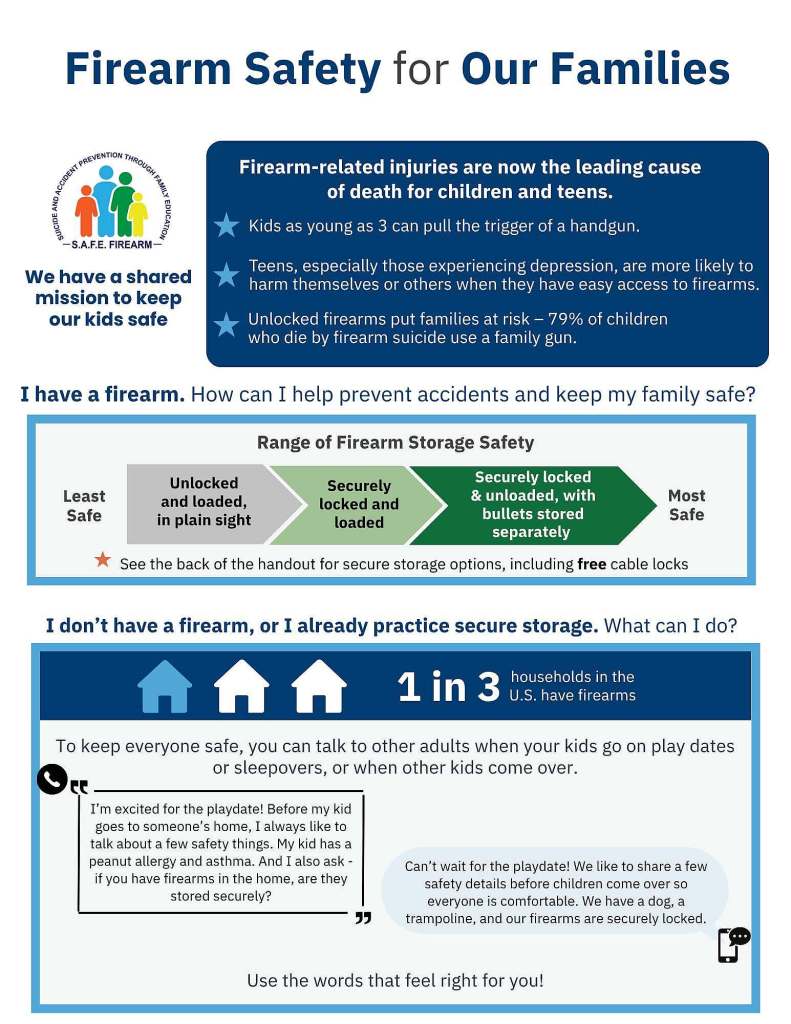
Kids may be curious if they find a gun when visiting friends or relatives. To make sure that your child will not have access to firearms on play dates or family visits, it can be helpful to have a conversation with the adult(s) in the home. If you’re not sure how to bring this up, please see the below resources.
Why is it important to store firearms so children and teens can’t access them without permission?
While children and teens can certainly know and learn how to handle firearms responsibly, it is still important to store firearms so that they cannot access them without permission. If children and teens are able to access firearms without your permission and/or do not know how to handle them properly, accidents can occur. Research has found that:
- 3 in 4 children ages 5-14 knew where firearms were hidden in the home, but 39% of their parents mistakenly thought that their child did not know the location of firearms
- 1 in 3 children ages 5-14 had handled a firearm in the home but 22% of their parents mistakenly thought that their child had never handled a firearm
- By the age of 3, some children are strong enough to pull the trigger of a handgun: 25% of 3- to 4-year-olds are strong enough to pull a trigger, and 70% of 5- to 6-year-olds are strong enough to pull a trigger
Furthermore, it is important to acknowledge that not all young people who come into your home will know how to handle firearms responsibly, so preventing firearm access without permission can be important for keeping young people safe. Lastly, when young people are experiencing a crisis, such as thoughts of harming themselves, it is important to think about how you can help keep them safe — for example, by making sure they can’t access medications or a firearm in your home without your permission.
- Project ChildSafe has a few videos that speak to this in more detail.
- The National Shooting Sports Foundation also has a flyer that reviews information about firearms responsibility in the home. (English/Spanish)
Where can I learn more about how to handle and use firearms responsibly?
Firearm ownership is a responsibility that must be taken seriously. Learning proper safe firearm handling and storage is important for maintaining a safe environment. Many local firearm dealers offer training about how to handle and use firearms responsibly, and they may also have a list of courses offered in your area.
- The Illinois Department of Public Health offers a number of online resources
- This guide for Firearm Safety and Patient Health also includes many helpful resources for firearm safety.
- Walk the Talk America also offers many online resources. Their organization operates at the intersection of firearm culture, mental health, and public health, offering practical tools, education, and collaborative partnerships that reduce negative outcomes while respecting responsible gun ownership.
Resources about suicide
When someone you love, like a child, is experiencing mental health challenges or thoughts of suicide or self-harm, it can be very difficult to know what to do. That person’s primary care provider or mental health provider can help them — and you, if you are involved in their care — to think through strategies to keep them safe. If you are looking for additional resources about how to help a loved one who is experiencing thoughts of suicide, please see the resources below.
- The American Foundation for Suicide Prevention (AFSP) offers many online resources for parents and caregivers.
- The Suicide Prevention Resource Center has resources for parents and guardians here. Their resources cover a variety of topics, including how to talk to a child who you think might be having thoughts about wanting to harm themselves.
- When someone in your home is experiencing suicidal ideation, it is important to limit their access to things they could use to harm themselves, including medications and firearms. Project ChildSafe and the American Foundation for Suicide Prevention have collaborated to create resources for firearm-owning parents to help them understand youth mental health and how to prevent unauthorized access to firearms.
- Many firearm sellers participate in programs such as Walk the Talk America, which allows firearm owners to temporarily bring their firearms to a firearm seller for safe keeping when needed — for example, if someone in the home is experiencing a mental health crisis. For more information, please see this brief video about the program here.
In the event of an emergency, please contact:
National Suicide Prevention Lifeline:
- English/Spanish: 988
- For people who are deaf or hard of hearing:
- You can reach out to 988 Videophone by calling 988 with a VP number.
- Online Chat
- English: Text HOME to 741741 or 443-SUPPORT in WhatsApp
- Spanish: Text HOLA or AYUDA to 741741 or 442-AYUDAME in WhatsApp
Resources for people experiencing interpersonal or domestic violence
If you are concerned about domestic or interpersonal violence against you or someone else — using a firearm or not — there are many organizations who can provide assistance. Please see a list of resources compiled by Futures Without Violence here.
Please note that our S.A.F.E. Firearm study team is not affiliated with the organizations referenced on this resources page, nor are we responsible for any content included on their respective websites.

 English
 Spanish